The biggest criticism of incentives is simple: once rewards end, the liquidity leaves with them. From there, many teams and users conclude that incentives don't work.
In most cases, nothing went wrong. Liquidity moving to a better opportunity is how DeFi works: switching costs are close to zero, and every LP is looking for the best place to put their capital. Fighting that is a losing battle.
The programs that last take a different approach. They use incentives to bring the right liquidity in fast, then make sure the product is still the best option once rewards stop. This deep dive explains how to do both, based on what we have seen across 50,000+ campaigns on Merkl.
In short
- Every LP optimizes for yield, risk, and passivity. Loyalty can't be bought, with locks or with networks.
- The real lever is being found: the more qualified LPs see your opportunity, the lower your cost of liquidity.
- Incentives pay off when they are structural or when they bootstrap network effects.
- Liquidity lasts when your product is still the best option once rewards taper.

Every LP is optimizing, and that's fine
Whether an LP allocates to a position comes down to three things:
- The yield, current and projected. Points that may convert into an airdrop count here too.
- The risk they perceive: smart contract risk, asset risk, the track record of the protocol.
- How passive the position is: how much attention it takes to hold it, monitor it, and exit it.
So when capital stays in an opportunity that looks suboptimal, it isn't loyalty. Either the LP doesn't know a better option exists, or they weigh the trade-off differently than you do. This is often called mercenary capital, but the word is probably too harsh. There is nothing wrong with this: every LP in DeFi optimizes to some degree, and it is better to build with that assumption than to be surprised by it.
Why loyalty can't be bought
If LPs follow yield, risk, and passivity, any promise of loyal capital deserves a second look. Three common approaches fall short.
Networks of LPs who stay. A group of LPs who actively look for opportunities is, by definition, optimizing. They will show up for a good deal, and leave for a better one. An LP network can help with distribution, but it is not a moat for retention.
Lockups. Locks don't remove the exit, they schedule it. TVL looks sticky until unlock day, then leaves all at once. Meanwhile, LPs price in the illiquidity, so you need a higher APR to attract the same dollar of liquidity.
Penalties and complex mechanics. Slashing on withdrawal or non-linear vesting create edge cases, and every rule is an attack surface that the most sophisticated farmers will find first. They also turn your APR into a conditional promise that LPs can't easily compare.
This is why most campaigns on Merkl are simple and linear: what you earn is proportional to how much you provide and for how long. Merkl does support vesting, holding periods, and fully custom logic when a program genuinely needs it. But if you need a penalty to keep capital, the incentive is probably masking a product problem.
The real lever: being found
If capital follows the best opportunity, the leverage is not in holding LPs back. It is in making sure the right LPs find you in the first place. When your opportunity is genuinely better on yield, risk, or passivity for some segment of users, the only thing standing between you and that capital is whether those users know it exists.
That is the network Merkl has built. Not a network that holds your position out of loyalty, but a large base of qualified LPs who recognize a good opportunity when they see one, and move fast when the terms are right:
- The Merkl App, where more than 200,000 LPs come every month to compare roughly 1,000 live opportunities.
- Partner frontends, where the Merkl API displays your reward APR to more than 5 million users, in the interfaces of Coinbase, Aave, Morpho, Uniswap, and others.
This reach is what brings net new liquidity: LPs who were not in your protocol before, and who chose your opportunity themselves. It is also why distributing through Merkl usually gets you the lowest cost of capital: the more qualified LPs see your incentives, the less you need to pay to reach your target TVL. We cover this marketplace model in depth in how to source liquidity providers for your DeFi protocol.
When incentives are worth it
Whether you call it an incentive program or liquidity mining, rewards never make up for a lack of product market fit. They can hide the problem for a while, but they will never fix it. Incentives work in two situations.
When they are structural and sustainable. Stablecoin yield is the clearest example: stablecoin issuers and fintechs share part of the yield generated by their reserves with the holders and depositors who use them. The incentive is not a temporary boost, it is part of the product. Earn sections work the same way, and Robinhood uses Merkl to keep its Earn yield on target.
When they bootstrap network effects. Some products need liquidity before they can become useful:
- Lending markets need to seed both supply and borrow demand. Borrowers come when there is liquidity to borrow, and lenders come when there is demand to earn from.
- New vaults have no track record. Early depositors take more risk than those who join once the vault holds $100M, and they deserve a higher reward for it.
- New chains and new pools need a first layer of liquidity before integrators, aggregators, and organic users start routing to them.
In both cases, the incentive buys something that stays once the rewards end: a working product, an established market, integrations, a track record. If your incentives aren't building any of these, you are probably just paying for TVL that will leave with them.
What it costs to attract liquidity
"What TVL will my incentives attract?" is one of the most common questions campaign creators ask. The honest answer is that it depends, because the cost of liquidity is relative. Four factors drive it:
- What others pay for the same liquidity: your rate competes with every comparable opportunity.
- The underlying asset: BTC liquidity is usually cheaper than USDC or ETH, because its holders have fewer ways to earn on it.
- The type of opportunity: a concentrated liquidity pool costs more than a lending market, and a new protocol more than a blue chip like Aave or Morpho.
- Your distribution: the more qualified LPs see your incentives, the less you pay to reach your target.
We will cover how to estimate the TVL a given budget can bring in a dedicated article, along with a simulator the Merkl team is building for campaign creators.
From bootstrapped to lasting liquidity
If you want incentives to bootstrap a market sustainably, the key question is simple: once rewards stop, what will make your rate, your trust, and your product still beat the alternatives? Four practices help answer it.
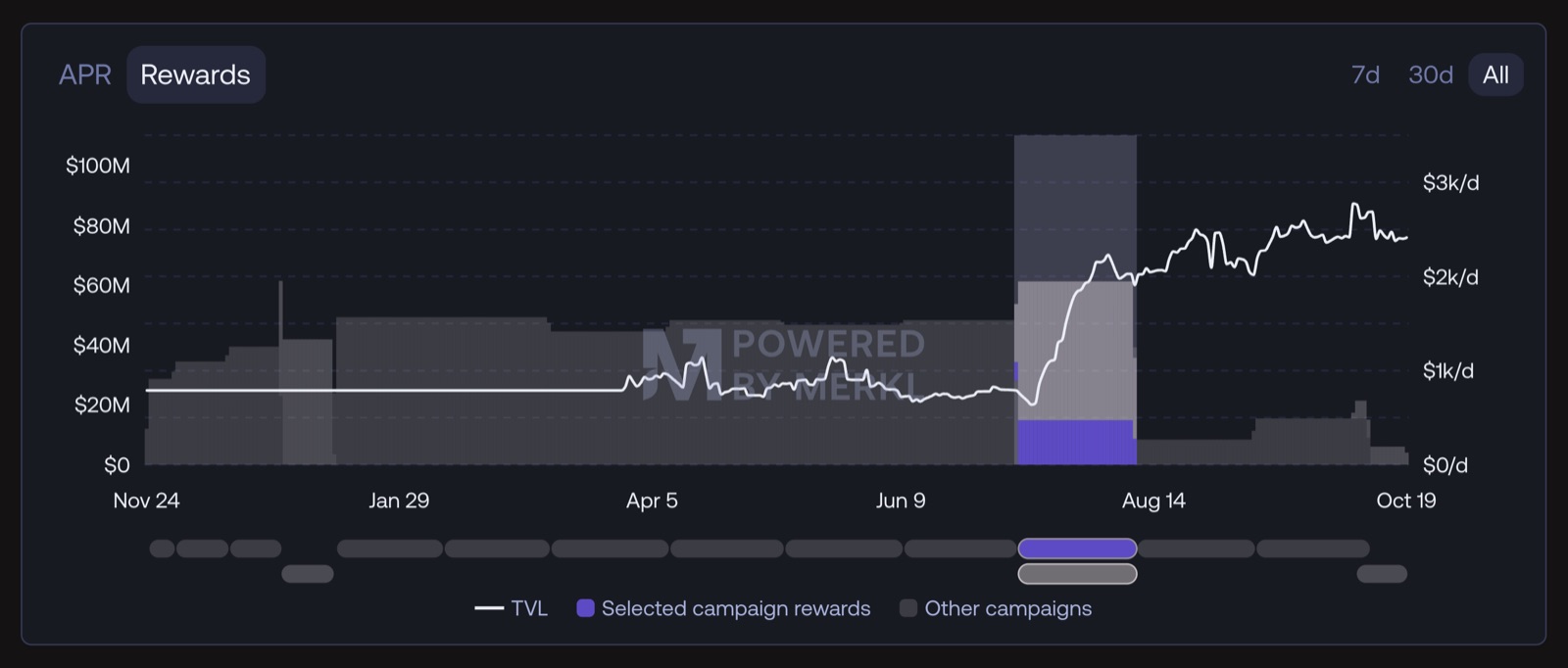
Taper rewards instead of stopping them. A hard stop turns your opportunity from competitive to below market overnight, and LPs leave together. Reducing rewards step by step lets you find the level where your native yield and product carry the liquidity on their own. USDC supply on Morpho markets on Monad shows what this looks like: when rewards were boosted in July, TVL tripled in a month. When rewards were then cut by 86% in August, TVL kept growing, peaking above $85M in October. When its last campaign ended on October 19, it still stood at more than $75M, against around $20M before the July boost. The same pattern held at scale on Base: when MORPHO rewards on USDC supply on Morpho markets were halved in January 2026, TVL kept growing, from around $1.2B to nearly $1.46B.
Benchmark against comparable alternatives. Liquidity moves when your rate falls below a similar opportunity, with similar size, liquidity, and trust. Sometimes it takes a while because less active LPs are slow to react, but it moves in the end. Track where you stand against the opportunities your LPs would realistically switch to.
Use the liquidity to build what stays. Integrations, aggregators routing to your pools, borrow demand that follows supply, a track record that lowers perceived risk. Liquidity attracts more liquidity, and this is what keeps TVL in place when rewards fade.
Measure retention, not just peak TVL. Peak TVL during a campaign says little about what you bought. What matters is how much liquidity is still there 30 days after rewards end, and how much of it is net new.
How Merkl helps
You will never hear us claim that the liquidity Merkl helps you attract will stay forever. What we do is give you the tools to attract the right liquidity at the lowest cost, and to see clearly what stays.
- Reach. Your campaign is live on the Merkl App and partner frontends from day one.
- Simple by default, custom when needed. Linear rules LPs understand at a glance, with minimum deposit durations, vesting, boosts, and custom logic when a program needs them.
- Rates that stay competitive. With a Target APR, you only pay the gap between your native yield and the APR you set.
- Measurement. TVL, APR, and rewards distributed for every campaign, in Merkl Studio and through the Merkl API.
- Guidance, with you in control. With Merkl services, our team pressure-tests your strategy and recommends calibrations, from the first campaign to the tapering plan. Your team keeps the final call.
To set up your first program, see how to launch a liquidity incentive campaign in 6 steps.
Key takeaways
Every LP optimizes for yield, risk, and passivity, and no lock, penalty, or network turns that into loyalty. The lever is getting found by the right LPs, at the lowest cost, then making sure your product is still the best option once rewards stop. Use incentives where they build something that lasts, taper them instead of cutting them, and measure what is still there 30 days later.
Ready to attract liquidity that lasts?
Reach qualified LPs, taper with confidence, and measure what stays.
FAQs
Does liquidity always leave when incentives end?
Not necessarily. Liquidity leaves when your total yield falls below a comparable alternative, because LPs allocate based on yield, risk, and passivity, and switching costs are close to zero in DeFi. If your product stays competitive, liquidity can stay even as rewards decrease: on Morpho markets on Monad, USDC supply kept growing after rewards were cut by 86%.
What is mercenary capital, and should I avoid it?
Mercenary capital is liquidity that moves to wherever the yield is highest, and leaves when rewards stop. You don't need to avoid it: every LP optimizes for yield, risk, and passivity to some degree. What matters is attracting it at the lowest cost, and making sure your product is still the best option once rewards taper.
Can incentives create permanent TVL?
Not on their own. Incentives bring liquidity in fast, but what keeps it is your product: a competitive native yield, low perceived risk, and the integrations and network effects the liquidity helps build.
Do lockups and vesting improve liquidity retention?
Rarely in the long run. Lockups don't remove the exit, they schedule it, and LPs ask for a higher APR to compensate for the illiquidity. Simple, linear campaigns are usually more efficient.
How do I lower my cost of liquidity?
It depends on what comparable opportunities pay, the underlying asset, the type of opportunity, and your distribution. Distribution is the factor you control most directly: the more qualified LPs see your incentives, the less you need to pay to reach your target TVL.
How do I measure the net new liquidity my incentives brought?
Compare TVL during the campaign with TVL before launch, count the depositors who had no prior position in your protocol, and check how much liquidity remains 30 days after rewards end. Merkl Studio and the Merkl API track TVL, APR, and rewards distributed for every campaign.
Can a platform guarantee the TVL my incentives will bring?
No one can honestly guarantee TVL, because it depends on market conditions and on what every other protocol pays. A platform can help you estimate it, reach qualified LPs, and measure results transparently. If a platform charges you based on the TVL it claims to have brought you, ask who decides which TVL counts as theirs.
Related articles

Deep dives|Oct 20, 2026|7 min read
No Claim Needed: How Merkl Autoclaim Pushes Rewards Straight to Wallets
Claiming is optional on Merkl. Autoclaim pushes rewards straight to user wallets, with no transaction to sign. How it works for users and teams.
Read more →
Deep dives|Oct 8, 2026|11 min read
How to Launch a Liquidity Incentive Campaign in 6 Steps
How to launch a liquidity incentive campaign in 6 steps with Merkl Studio: set targets, pick a reward model, pay for liquidity that stays, and acquire LPs.
Read more →
Deep dives|Sep 14, 2026|8 min read
Stablecoin Mass Payouts vs Traditional Payout Providers: What Actually Changes
Stablecoin mass payouts compared with banks and payout providers: cost structure, settlement speed, failure modes, compliance, and when each rail wins.
Read more →