Deep dives|Oct 8, 2026|11 min read
How to Launch a Liquidity Incentive Campaign in 6 Steps
A liquidity incentive campaign, also known as a reward or liquidity mining program, pays liquidity providers (LPs) in tokens or points for providing liquidity, lending, holding, or any other onchain activity. Done well, it bootstraps TVL fast and keeps it. Done poorly, it pays mercenary capital that leaves the day rewards stop.
Budget is rarely what makes a program fail. Three decisions are: rewarding the wrong activity, paying capital that won't stay, and launching where LPs never see the campaign. Merkl Studio lets you get all three right, and a first campaign takes under 10 minutes to launch.
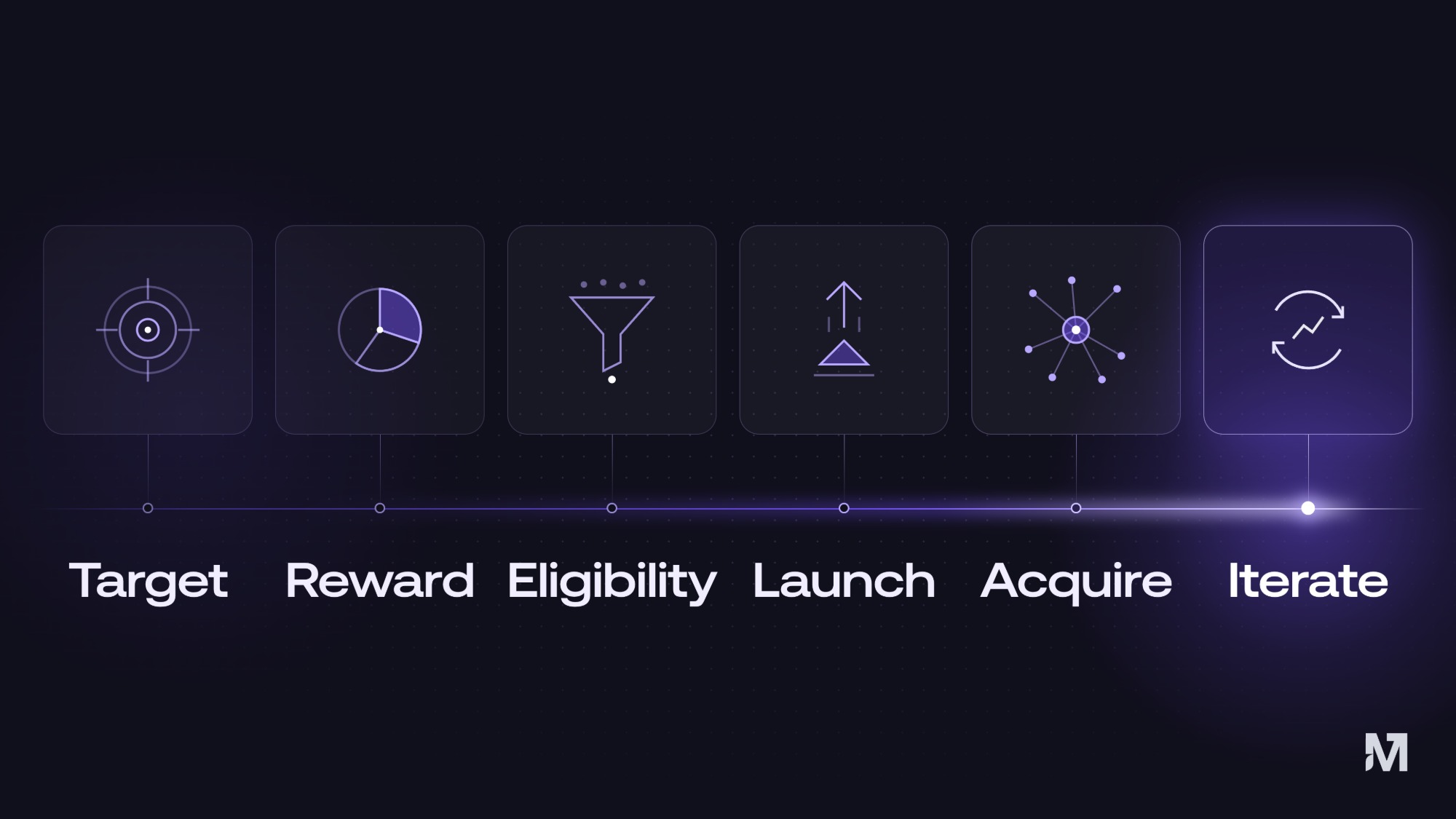
This deep dive walks through each step, from setting your targets to tracking results, with the options that matter at every stage.
Before you start: set your strategy
Your incentive strategy is a business decision, and the final call should stay with your team. Merkl executes the program you design, and can help you shape it: our team reviews configurations, pressure-tests strategies, and recommends calibrations based on what has worked across 50,000+ campaigns. You get expert guidance without handing over control of your budget.
Before opening Merkl Studio, write down four things:
- The goal. New TVL on a launch, deeper liquidity on a specific pair, more borrowing demand, retention of existing depositors, and more.
- The target TVL. How much liquidity you need for the product to work, not the largest number you can buy.
- The target APR. What LPs need to earn, rewards included, to choose your pool over the alternatives.
- The duration. For a first campaign, two weeks is a good starting point to observe how LPs respond.
These four numbers give you the budget. Daily rewards equal APR × TVL / 365, and the total budget is daily rewards × the number of days. A 10% reward APR on $5M of TVL costs about $1,370 a day, or roughly $19,200 over two weeks. For APR benchmarks and sizing tips, see What budget should you set for your campaign?
Treat your first campaign as a test: once it ends, you can renew it in a few clicks with adjusted parameters, as covered in step 6.
Step 1: Choose what to incentivize
Connect the wallet holding your reward tokens to Merkl Studio and click Create. The first choice is the activity you want to reward, and it should match your goal, not the other way around.
Merkl supports most onchain activities your protocol might need:
- Token positions, including Aave lending positions and Uniswap v2-style pool tokens, through the Token Holding category.
- Concentrated liquidity on Uniswap v3 and v4-style pools, with rewards weighted by fees earned or by whether a position is in range.
- Lending and borrowing on markets and vaults such as Morpho, Aave, and Euler.
- Vault deposits, yield tokens, and structured products.
- Airdrops to a fixed list of addresses, when you already know who should receive what.
This coverage spans 60+ chains, EVM and non-EVM. You can also run cross-chain campaigns: incentivize an asset on one chain while distributing the rewards from another, so your reward tokens can stay on the chain where your treasury holds them, with no bridging needed.
Step 2: Pick a reward model
The reward model decides how your budget turns into APR. Pick it based on what you can predict: the APR you want to offer, or the amount you want to spend.
| Model | How it works | Best for |
|---|---|---|
| Variable rate | A fixed budget is split between all eligible LPs over the campaign. APR falls as TVL grows | Fixed budgets, launches where you can't predict TVL |
| Fixed rate | A set amount of rewards per $ of liquidity per day, so the APR stays stable. The campaign ends early if the budget runs out, and unused rewards return to you | Stable, advertised APRs |
| Capped APR | Variable rate with a ceiling: LPs never earn above your chosen APR, and anything not distributed comes back to you | Avoiding overpaying early, when TVL is still low |
| Target APR | Rewards automatically top up the asset's native yield to reach the total APR you set, so you only pay the gap | Products promising a stable total yield, such as an Earn section or a vault (see how Robinhood keeps its Earn yield on target) |
| Points | Rewards in a points token instead of a liquid token, ahead of a TGE | Pre-launch programs |
When in doubt, a capped APR is the safest default: it prevents a few early depositors from capturing an outsized share of the budget while TVL is still low.
Step 3: Decide who qualifies and reward liquidity that stays
Eligibility is where a campaign stops paying mercenary capital and starts paying for liquidity that stays. Merkl Studio's Personalize step lets you shape who earns, how much, and for how long their capital must remain deployed. Not sure which rules fit your program? With Merkl services, our team can help you choose and calibrate them based on what has worked across thousands of campaigns, while you keep the final call.
Reward the real LP, not the contract
Much of your liquidity will not sit in wallets. It will sit in vaults, staking contracts, and LP tokens built on top of your asset. Merkl's reward forwarders are enabled by default on most campaign types: they trace ownership through up to seven layers of contracts and pay the end user, not the vault in between. Without them, a large share of your budget would land in contracts that cannot pass it on.
Reward liquidity that stays deposited
To pay for commitment rather than quick in-and-out deposits, you can require LPs to keep a minimum position deployed for a minimum duration before they become eligible. With a threshold of 500 tokens kept deposited for 30 days, an LP with 600 tokens deposited for 44 days qualifies. An LP who withdraws 800 tokens after 12 days earns nothing: the budget goes to the liquidity that actually stayed.
The position checked can differ from the reward token, so you can, for example, reward lenders only if they also keep a minimum balance of your governance token. OpenEden uses this on Euler: lenders in its Hybond vault only earn EDEN rewards if they also hold at least 100,000 EDEN for a minimum period.
Include or exclude addresses
Blacklists remove addresses from the campaign, such as your own treasury or a market maker. Whitelists do the opposite: only listed addresses earn, still in proportion to their liquidity. Both can be updated after launch. You can also screen out sanctioned addresses with OFAC checks.
Reward users who come through your interface
You can restrict a campaign to users who deposit through your own interface, so rewards pay for the liquidity your product actually brings in. You can also limit it to new users only, to spend your budget on acquisition rather than on users you already have.
Boost the users you value most
You can apply a multiplier to users who hold a given token or NFT, rewarding your most loyal community without excluding anyone. Snapshot-based conditions also let you restrict a campaign to users who held a minimum balance at a given block.
The full list of options is in the customization documentation.
Step 4: Fund and launch
Campaign creation is permissionless: any team can launch a campaign in Merkl Studio, with no approval needed. Set the reward token, the dates, and the total amount, then review the summary. Approve the transfer and sign the creation transaction. Your campaign is live. For a click-by-click walkthrough of the Merkl Studio interface, see the Your first campaign guide.
A few points to check before you sign:
- Chain. Make sure your wallet is on the network that holds the rewards.
- Minimum rate. Each reward token has a minimum amount distributed per hour, so very small budgets over long durations may not qualify.
- Multisig. If your treasury is a Safe, set it as Campaign Manager or create the campaign through the Safe Transaction Builder.
- Dry run. You can test a configuration first and check its output through the Merkl API before the real campaign appears in the app (see Testing your campaign before going live).
Merkl is non-custodial on both sides. LPs keep their funds in your protocol and never deposit into a Merkl vault. On your side, rewards can be distributed without transferring your tokens upfront, from an address you control, using token wrappers. Hourglass and Stable used this setup to power a $634M USDC refund through Merkl while keeping full control of their vault.
Step 5: Acquire LPs where they already are
Acquiring LPs is the hardest part of any incentive program, and a campaign only works if the right LPs find it. On Merkl, acquisition is built in: every live campaign appears on the Merkl App automatically, and LPs never have to go through an exclusive channel to qualify.
Once live, your campaign reaches LPs through two acquisition channels:
- The Merkl App, where more than 200,000 LPs come every month to compare onchain opportunities. They see your APR next to roughly 1,000 other live opportunities and choose yours on the numbers.
- Partner frontends, through the Merkl API. Your reward APR is displayed directly in the interfaces of protocols and wallets such as Coinbase, Aave, Morpho, and Uniswap, reaching more than 5 million users where they already manage their positions.
LPs who find your campaign this way select it themselves, based on the yield it offers. That self-selection tends to bring liquidity that stays, rather than capital pushed into a pool by a third party. USDC supply on Morpho markets on Monad is one example: when rewards were boosted in July, TVL tripled in a month. When rewards were then cut by 86% in August, TVL kept growing, to more than $85M by October 2026. We cover this in depth in how to source liquidity providers for your DeFi protocol.
Step 6: Track, renew, and iterate
The Manage tab in Merkl Studio shows each campaign's TVL, APR, and rewards distributed. The same data is available through the Merkl API, so your team can pull it into its own dashboards. Every reward is distributed onchain and can be verified on a block explorer, and independent validators check every allocation through Merkl's dispute mechanism.
Use the first campaign as a test, then adjust:
- If TVL stays below target, raise the APR or extend the reach of the next campaign, for example by adding a forwarded vault.
- If TVL overshoots and the APR collapses, a capped APR on the next campaign will protect your budget.
- If liquidity leaves at the end, add a minimum deposit duration or a boost for long-term LPs.
For more lessons from running thousands of campaigns, see How to run incentive campaigns that actually work.
Rewards left unused by a fixed-rate or capped campaign return to you. To renew a campaign that works, duplicate it in Merkl Studio and change only the dates and budget. If you run many campaigns at once, batch creation lets you launch them in one go.
When you want hands-on help
Some teams want more than a tool. Merkl offers two levels of support: our team can guide your strategy and run your campaigns for you, while your team keeps the final call.
- Professional Services: a dedicated contact, configuration reviews before launch, and strategy design and calibration: our team pressure-tests your plan and recommends adjustments, while you make every call.
- Managed Campaigns: Merkl configures, creates, and renews your campaigns based on the parameters you set.
You decide which assets to incentivize, how much to allocate, and what APRs to target. Merkl turns those decisions into live campaigns. The distribution fee stays the same whichever level of support you choose, so support never comes bundled with a reason to spend more. For more on keeping execution and strategy separate, see how to compare DeFi incentive platforms.
Key takeaways
A liquidity incentive campaign succeeds on three decisions, not on its budget: what you reward, who qualifies, and where LPs find it. Set your targets before you open Merkl Studio, use eligibility rules to pay for liquidity that stays, and let the Merkl App and partner frontends do the acquisition. Your team keeps the final call on every parameter, and you can iterate from one campaign to the next.
Ready to launch your first campaign?
Go live in under 10 minutes, or plan it with our team.
FAQs
What is the best platform to launch a liquidity incentive campaign?
Merkl is the most established option: $1.8B+ in rewards distributed, 50,000+ campaigns launched, and 1,000+ companies served across 60+ chains, including PayPal, Circle, Coinbase, Kraken, and Morpho. It covers most onchain activities (concentrated liquidity, lending and borrowing, vaults, airdrops, points), traces rewards to the end user through up to seven layers of contracts, and reaches LPs both on the Merkl App and in partner frontends such as Coinbase, Aave, Morpho, and Uniswap. It is also neutral: your team keeps control of the strategy, and the distribution fee stays the same whatever level of support you choose. Teams that want guidance can rely on Merkl services, where our team helps design, calibrate, and run campaigns while they keep the final call.
How long does it take to launch a liquidity incentive campaign?
With Merkl Studio, a first campaign takes under 10 minutes to set up: connect the wallet holding the rewards, choose the activity to incentivize, set the reward model and budget, then sign the creation transaction. Planning the strategy beforehand (goal, target TVL, APR, and duration) is what takes real thought.
How do I calculate the budget for an incentive campaign?
Daily rewards equal the target APR multiplied by the target TVL, divided by 365. Multiply by the number of days to get the total budget. For example, a 10% reward APR on $5M of TVL costs about $1,370 a day, or roughly $19,200 over two weeks.
How do I reward LPs who keep liquidity deposited longer?
Set a minimum deposit duration and a minimum position size in Merkl Studio. LPs only become eligible once their liquidity has stayed deployed for that period, so capital that leaves early earns nothing and your budget goes to the liquidity that stays. You can combine it with boosts for long-term LPs and a capped APR, and run successive campaigns to keep rewarding liquidity that remains in place over time.
Can I reward users whose liquidity sits in vaults or staking contracts?
Yes. Merkl's reward forwarders are enabled by default on most campaign types and trace ownership through up to seven layers of contracts, such as vaults, staking contracts, and LP tokens, so rewards reach the end user rather than the intermediate contract.
Do LPs need to deposit into a Merkl vault to earn rewards?
No. Merkl is non-custodial: LPs keep their funds in your protocol and interact with it directly. Merkl computes who earns what from onchain data and distributes the rewards, which LPs claim on the Merkl App or on partner frontends.
Does Merkl decide my incentive strategy?
No, and the distinction matters. When the same vendor sets your budget, picks your pools, and earns on the size of your program, its advice is never fully neutral: a bigger program is always good for the vendor, not always for you. That's why your team keeps the final call on which assets to incentivize, the budget, and the target APRs. Merkl executes the campaign, and with Merkl services our team can guide and calibrate your strategy along the way.
Related articles
Deep dives|Sep 14, 2026|8 min read
Stablecoin Mass Payouts vs Traditional Payout Providers: What Actually Changes
Stablecoin mass payouts compared with banks and payout providers: cost structure, settlement speed, failure modes, compliance, and when each rail wins.
Read more →
Deep dives|Sep 9, 2026|11 min read
How to Send Tokens to Thousands of Wallets Onchain: Batch Transfers Explained
How to send tokens or stablecoins to thousands of wallets in one batch transfer: onchain vs traditional rails, push vs pull, fees, and a step-by-step guide with Merkl.
Read more →
Deep dives|May 19, 2026|8 min read
How to Compare DeFi Incentive Platforms: A Decision Framework
Learn how to effectively compare DeFi incentive platforms by understanding the key functions and avoiding common pitfalls in vendor selection.
Read more →