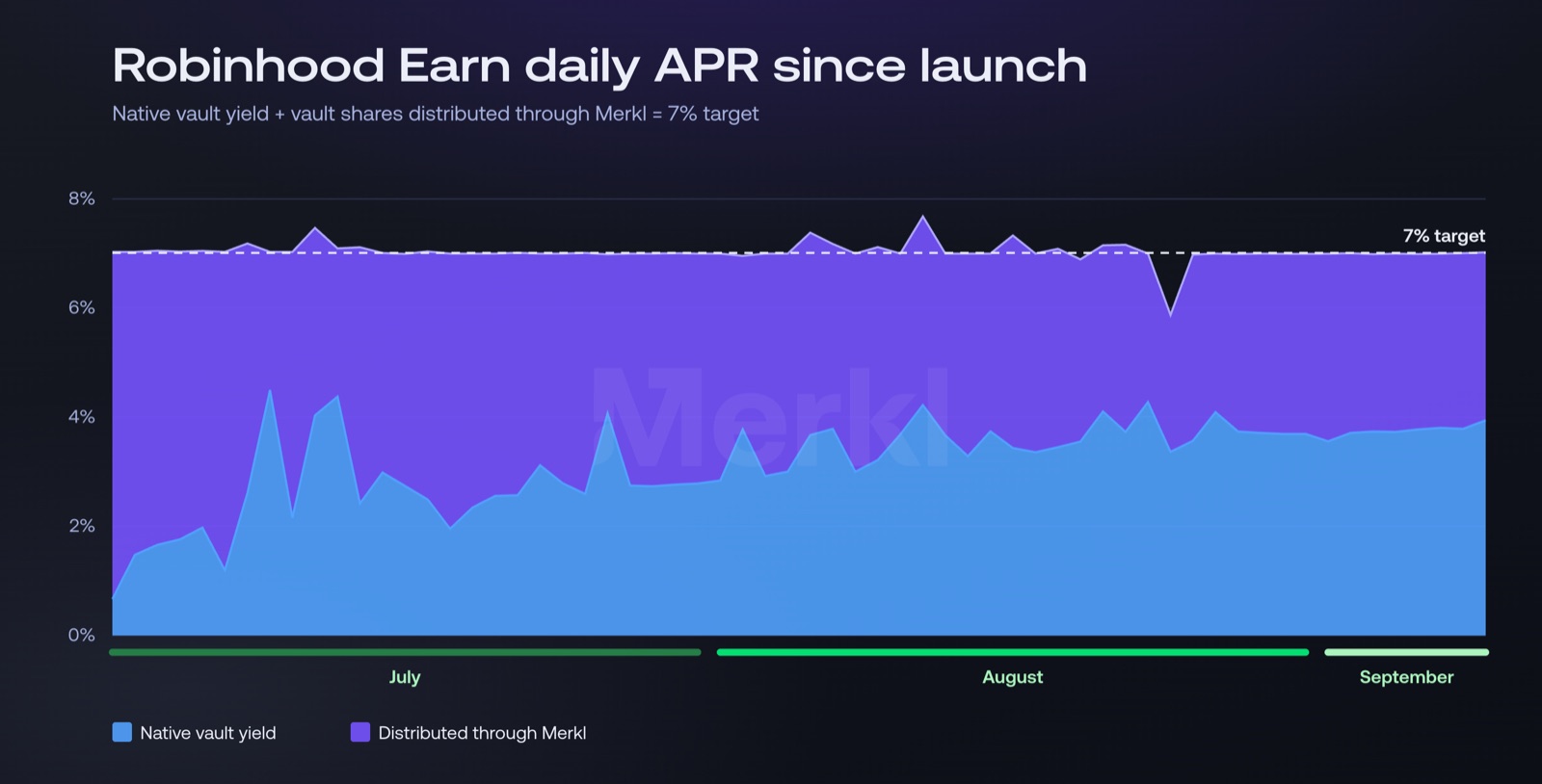
Challenge
On July 1, 2026, Robinhood launched Robinhood Chain, a permissionless Layer 2 built for financial services and tokenized real-world assets. With it came Robinhood Earn, a new way for eligible US customers to put stablecoins to work: lend USDG onchain directly in the Robinhood app, through a self-custody wallet built into it. The promise is simple: earn yield on your USD, with no lockup.
Under the hood, deposits flow into a Morpho vault. The vault generates native yield as USDG is lent out. But native lending yield alone was not enough. It sits well below the rate Robinhood wanted to offer its users, and it moves with market conditions, rising and falling with utilization day after day.
Two challenges, one requirement. The yield had to be topped up to reach an attractive rate, and the top-up had to adjust constantly to keep that yield sustainable over time, whatever the native yield does. Robinhood needed that machinery without building and maintaining it in-house, and without a single token going to the wrong address.
Solution
Keeping an earning rate on target, whatever happens: that is exactly what Merkl is built for.
At launch, the rate was set to an estimated 7%. The vault’s native yield, driven by lending demand, follows its own path and rarely lines up with that target. Closing the gap, continuously, is Merkl’s job.
Users see one single rate in their Robinhood app. Behind that number, it combines two sources:
- The native yield the vault generates as USDG is lent out
- Extra vault shares distributed through Merkl on top, calibrated to reach the target rate
Merkl is the engine behind the rate. It measures the vault’s native yield against the target and distributes exactly what is needed to cover the difference. And this is not a one-time setup. As the native yield and the vault’s size move, Merkl recalculates and adjusts what it distributes. Merkl handles both the calculation and the distribution.
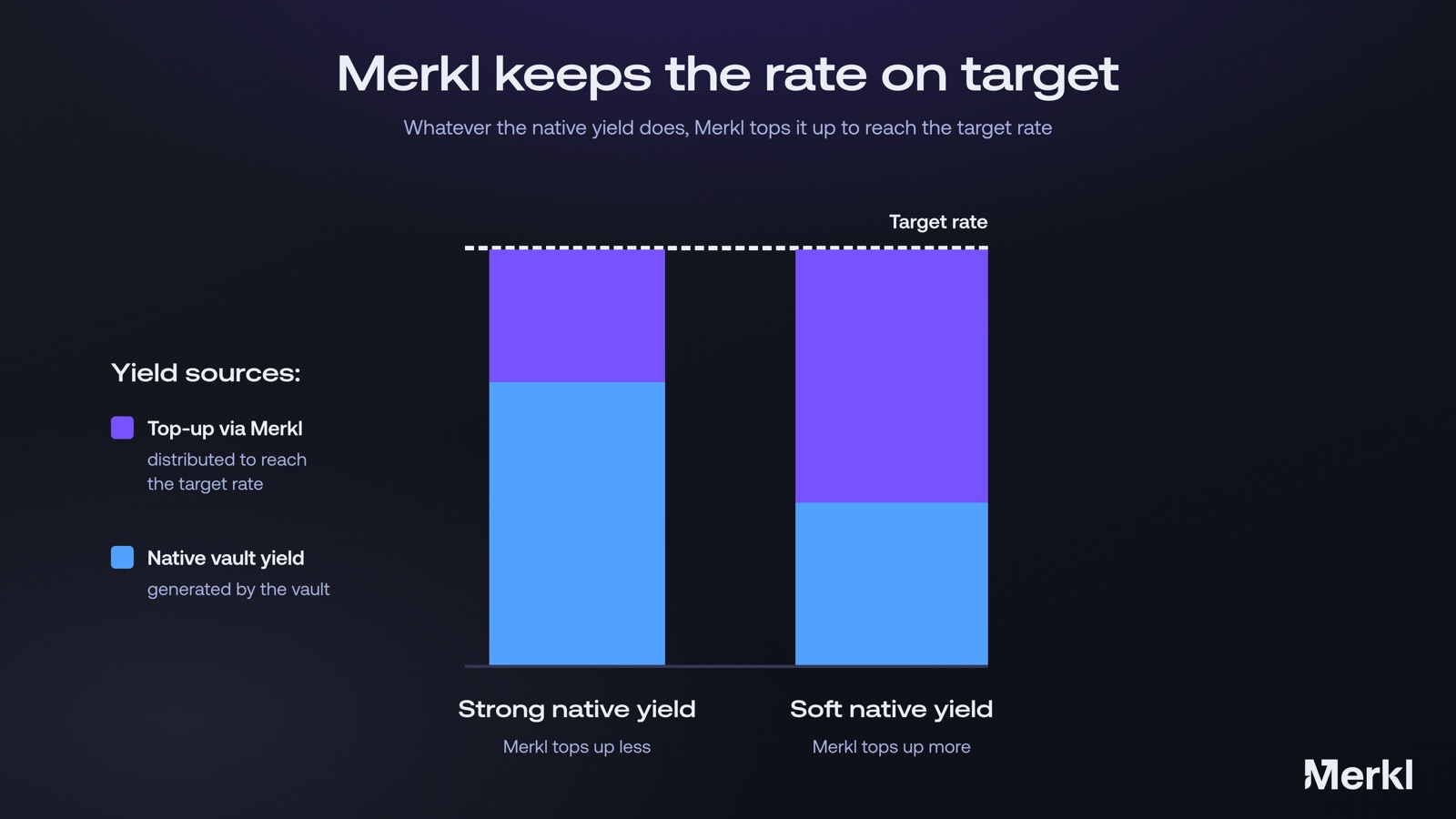
Three details make the mechanism precise:
- The top-up is paid in vault shares. Users receive shares of the same Morpho vault, so their earnings start compounding right away. Nothing to restake, nothing to manage.
- Distribution is strictly scoped. Extra vault shares go only to users who deposited through Robinhood, in proportion to their stake in the vault. Other depositors in the same vault are unaffected.
- Everything runs onchain. Deposits, native yield, and the Merkl distribution are all verifiable on Robinhood Chain.
For users, the experience is a few taps in the Robinhood app: fund with USDG, deposit into Earn, and the balance starts earning. Merkl handles the rest in the background.
Results
Robinhood Earn launched with Robinhood Chain in July 2026, with Merkl part of the stack from day one. The product crossed 1,000 users within its first days, and the growth has not stopped since.
- $455M+ in USDG deposited into the Steakhouse USDG vault, now the largest vault on Morpho (September 2026)
- 95,000+ wallets earning through the program
- $1.7M+ in vault shares distributed through Merkl since launch, at a current pace of over $37K per day
- Robinhood Chain crossed $1B in TVL in August 2026, with $800M of it on Morpho
- The rate has stayed on target: in early September, the vault’s native yield sat at 3.86% and vault shares distributed through Merkl added 3.24%, landing eligible depositors at the 7% target
That last number is the mechanism working exactly as designed. Native yield moves, the Merkl distribution adjusts, and the rate users see does not flinch.