How Sky Protocol Rewards USDS Holders Without Overpaying Thanks to Merkl

Challenge
Sky Protocol operates USDS and sUSDS, with a growing family of USDS-denominated vaults running on Morpho. Depositors supply liquidity to the vaults, which route that capital into Morpho markets where USDS can be borrowed.
USDS reserves generate yield. To make USDS more attractive across DeFi, Sky Protocol channels part of that reserve income into an incentive program on the vaults, layered on top of native vault returns.
The program is designed with a specific constraint: avoid overpaying for liquidity that's already generating yield. USDS supplied to a vault can be lent out to borrowers on Morpho markets, and that borrowed portion already earns the market borrow rate for depositors. Only the idle portion, sitting in the vault contract unborrowed, needs to be topped up with reserve-funded incentives.
That means the infrastructure has to do three things precisely at the same time:
-
track the idle USDS balance held in each whitelisted vault contract block by block
-
route incentives down through nested ERC4626 structures to the actual end depositor
-
bound spend to the Sky Savings Rate (SSR) applied on that idle portion, not on the total deposits.
Building this in-house, vault by vault, would mean months of custom engineering per venue and constant operational overhead to keep payouts aligned with what reserves are actually earning.
Solution
SkyMoney turned to Merkl to power its USDS incentive program on Morpho.
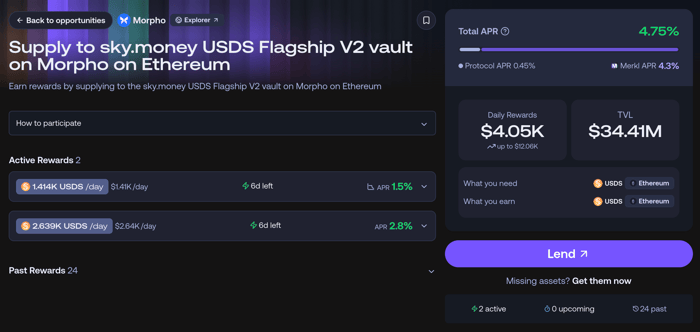
The program is built around Merkl's idle liquidity-based rewards mechanism. Sky whitelists the ERC4626 vault contract holding USDS, and Merkl tracks the time-weighted USDS balance sitting idle on that contract: the portion that hasn't yet been borrowed out to Morpho markets.
The economic logic is precise. Borrowed USDS already generates yield for depositors through the borrow rate paid by Morpho borrowers, so it needs no top-up. Only idle USDS, sitting in the vault contract unutilized, gets paid the Sky Savings Rate. Sky Protocol distributes SSR on the idle balance only, leaving the borrowed portion to earn from the market.
As a concrete example, with around $38M in total deposits and roughly $30M sitting idle, applying the SSR at ~3.6% on the idle balance translates into an effective ~2.9% APR for depositors on their full position.
Merkl's reward forwarders handle the last-mile problem: they route the incentives through every layer of the vault structure down to the depositor backing the position, regardless of how that user accessed the vault: directly on Morpho, through a third-party aggregator, or through any vault that deposits into the underlying market. The depositor sees a single reward stream; under the hood, Merkl routes across nested contracts.
When we needed to transition our incentive program, Merkl was the obvious choice. The setup was fast, depositors kept earning without interruption, and the composability of the reward structure took our program to the next level. The co-marketing support accelerated our growth well beyond what we could have achieved alone.

Results
At the time of writing, since March 2026, SkyMoney's USDS incentive program on Merkl has reached:
-
~$30M+ in live USDS TVL incentivized on the idle balance
-
~$440K+ in USDS distributed to vault depositors, settled weekly
-
SSR applied on idle balance only, keeping spend bounded by what reserves earn on the unutilized portion of the vault
-
Reward forwarders routing incentives through every layer of the vault structure down to the end depositor
Because the mechanism is venue-agnostic and reward-forwarder-native, the same idle liquidity-based setup can be extended to any new vault, market, or chain where USDS is held.
A natural next step would be to apply the same setup to the Morpho singleton contract directly: distributing SSR to USDS holders across all Morpho markets at once, with reward forwarders routing down to the underlying depositors regardless of how they accessed the position.
For any stablecoin issuer running a USDS-style incentive program funded by reserve earnings, SkyMoney's setup with Merkl is the working template.
