Skip to content

Liquidity provisioning

Create incentive campaigns to encourage users to provide liquidity within narrow ranges in Uniswap v3 and v4 pools, as well as on any other concentrated liquidity DEX

What you get

Precise targeting

Reward liquidity providers (LPs) based on how they provide liquidity (price ranges) or if they provide more of one token than another in a pool

 
Capital efficiency

Enable liquidity providers to earn more rewards when providing liquidity in narrower ranges

 
Optimal distribution Even reward LPs providing liquidity through Automated Liquidity Management (ALM) solutions
 

Check live liquidity provisioning campaigns

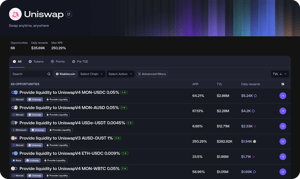
Explore the liquidity provisioning campaigns currently live in the Merkl App. Review their parameters, track TVL and APR evolution, and see how they are performing.

 

LP-live-campaigns-merkl
INCENTIVIZE — ENGAGE — GROW —

Start incentivizing in seconds

1
Choose an asset

Specify the asset, pool, market, or behavior that will be incentivized for users to earn rewards


2
Select incentives
Set the rewards to be distributed for your campaign (token, chain, amount, dates)
3
Launch campaign
Confirm options, details, and sign the transaction to start distributing incentives
Merkl stories

See how web3 teams attract liquidity with Merkl

FAQ

What is Merkl? Merkl is the leading incentive and point management platform, backed by a16z. We help protocols, blockchains, and wallets boost liquidity across any DeFi venue. Since our launch in November 2023, we've distributed over $200 million in incentives across 50+ chains, with 200+ protocols. We're the team behind all Uniswap, Morpho, Euler, Arbitrum, and Optimism incentives.
How do incentive platforms work? Incentive platforms automate and optimize the distribution of rewards based on user activity. They connect users with web3 projects looking to boost activity and engagement. Users perform actions (hold token, supply liquidity,…) and earn rewards, while web3 projects boost their growth (TVL increase, user engagement,…). There are different types of incentive platforms: custodial, non-custodial, social-focused, DeFi-focused, etc.
What types of incentive campaigns does Merkl support?

Merkl supports a wide range of incentive campaign types across 50+ chains:

- Liquidity incentives for concentrated liquidity pools (CLAMM) like Uniswap v3 & v4

- Lending & borrowing incentives across protocols like Aave, Morpho, and Euler

- Airdrops (to a predefined list or users meeting specific criteria)

- Rewards for ERC20 token holders, based on their balance over time (e.g., LP token holders)

- Point systems to drive engagement and retention

And we're constantly expanding with new use cases!

Does Merkl charge fees?

Campaign creation comes with a 3% maintenance fee, except for airdrop campaigns, which have a reduced 0.5% fee. Merkl is free for retail users, aside from gas fees.

For custom or long-term incentive programs, reach out to us — we’d be happy to discuss tailored pricing!

What are the best incentive strategies?

Choosing the right incentive strategy depends on your goals and needs. For instance, during a token launch, it’s often best to hold off on incentives until the price stabilizes, whereas for a stablecoin, building a liquidity wall can be a smart move. These are just a couple of many possible approaches.

Additionally, optimizing a campaign also means selecting the right reward distribution model—whether it's a fixed reward rate, variable reward rate, or event-based rewards (e.g., swaps, follows on X, etc.).

How to get started with Merkl incentives?

Distributing incentives with Merkl is quick and easy. Just head over to Merkl Studio, set up your campaign parameters (amount, chain, dates, etc.), and launch it in a few clicks!

If you're planning a large-scale incentive program, need advanced customization, or have any questions along the way, feel free to reach out — we’re here to help!

Ready to get started?