Monthly recap|Sep 10, 2026|5 min read
Summer Recap: July & August 2026 – Robinhood Earn, Coinbase Tokenized Stocks, and More
This summer, Merkl powered some of the most visible launches in onchain finance: Robinhood Earn went live with its rate managed through Merkl, Coinbase Tokenized Stocks launched on Base with a cashback program, and 1inch introduced Aqua with a volume-based incentive program. On top of that, we launched Merkl Services, a new way for teams to work with us beyond the platform.
Here is everything that shipped and happened in July and August.

Incentives campaigns
-
Robinhood Earn Robinhood Chain went live in July, and with it Robinhood Earn, a new way for eligible Robinhood users to earn yield on their stablecoins. Users lend USDG in the Robinhood App, and it starts working onchain in a Morpho vault curated by Steakhouse. Merkl powers the rate: on top of the vault's native yield, vault shares are distributed to reach the target rate, compounding automatically. Proud to be part of it from day one.
-
Robinhood Stock Tokens on Uniswap Uniswap v4 pools for Robinhood Stock Tokens went live on Robinhood Chain, with rewards for liquidity providers distributed via Merkl. Every stock token pairs against SP500 rather than a stablecoin, so both sides of the pool are equities and tend to move together. 11 pools launched, pairing SP500 with TSLA, AMZN, META, PLTR, AMD, MU, TSM, COST, RDDT and QQQ, plus the USDG/SP500 hub that stable trades route through.
-
Coinbase Tokenized Stocks Coinbase Tokenized Stocks went live on Base, with a cashback program running on Merkl. Users who buy AAPLc, GOOGLc, NVDAc or METAc through one of 11 eligible apps, including 1inch, Bitget Wallet, KyberSwap and Jumper, and hold through the end of the epoch earn up to 5% back in USDC. Incentivized cStocks vaults are also live through Beefy, IPOR and Superform.
-
Aave V3 on Monad Aave V3 went live on Monad, and supplying came with rewards from day one. Lenders supplying USDT0, USDC, AUSD, WETH and more earn WMON on top of native yield, distributed through Merkl. The market was deployed with support from TokenLogic.
-
Aave V4 on Avalanche Incentives went live on Aave V4's Avalanche deployment, powered by Merkl. Users earn by supplying USDC or USDT, or by borrowing AVAX.
-
First campaigns on Stellar The first incentive campaigns on Stellar went live on Merkl. Borrowers on the Templar XLM/USDC market earn XLM, claimable directly on Merkl, with the campaign reducing borrowing costs on the market. Upshift followed with its earnUSDC and earnXLM vaults curated by Gami Labs: supply USDC or XLM and earn on top, distributed through Merkl.
Chains supported
Merkl expanded to three new chains this summer.
Pharos went live on Merkl in July. Protocols building on Pharos can now distribute incentives through Merkl, and users can already earn: the first opportunity lets lenders supply USDC to the RockawayX vault on Morpho via Oku, with native lending yield topped up with PROS tokens toward a target rate.
Kaia also joined Merkl in July. Users can earn WKAIA by supplying to the Feather USDT vault on Morpho or on WKLAY borrow markets, with campaigns renewed weekly since launch.
Robinhood Chain also joined Merkl's supported chains, powering Robinhood Earn and the Stock Token liquidity pools covered above.
Protocols integrated
- 1inch on Ethereum and Base: 1inch launched Aqua, its new shared liquidity layer where one wallet balance backs many positions at once and tokens only move when a swap fills. Its first ever campaigns on Merkl kicked off the launch: a 3 month incentive program including 10M 1INCH, with rewards flowing to liquidity that gets used. The more swap volume a position handles, the more it earns, all tracked and claimable on Merkl.
- Templar on Stellar: users can borrow USDC on Templar's XLM/USDC and WBTC/USDC markets and earn XLM and USDC, distributed through Merkl. Templar is the first protocol live on Stellar through Merkl.
- Syntetika on Base: users can supply cbBTC to the Hilbert BTC vault and earn USDC and hBTC, distributed through Merkl.
New features
For users
Your rank on the leaderboard
The leaderboard now shows your rank. On any opportunity you've joined, connect your wallet to see your exact position and the total rewards you've earned, pinned right at the top. A search bar was also added, so you can look up any address and instantly find its position, share, and rewards.

AI search on the app homepage
Finding the right opportunity is now as simple as asking. Type a query in natural language on the Merkl App homepage, like "best stablecoin yield on Ethereum", and the AI search turns it into filters, explains what it applied, and returns a ranked list of matching opportunities. Results are AI-selected from the same live data as normal browsing.

Protocol trust badges
Opportunity pages and protocol pages now display key protocol information sourced from DefiLlama: audits, protocol TVL, past incidents, and the date the protocol was listed. One click on the info badge next to a protocol's name, and you know who you are depositing with before you commit funds.
Filter by creation date
You can now filter opportunities by when they were created: last 7 days, 30 days, 90 days, last year, or a custom range. Handy for catching fresh opportunities early, when rewards are often at their most attractive. Filters have also been reordered based on usage, so the ones you reach for most sit at the top.
Cleaner claim page
Claimable reward cards worth $0.01 or less are now hidden in the app, keeping your claim page focused on rewards that matter. These dust amounts remain claimable directly from the contract.
For companies
Merkl Services
Not every team wants to spend its week configuring campaigns, setting APRs, adjusting eligibility, and renewing them instead of building their product. So we launched Merkl Services: three ways to run your distribution on Merkl, depending on your level of involvement. Self-Serve, where you run everything end to end with standard support included. Professional Services, where you stay in control and remain the creator of every campaign, with a dedicated point of contact, priority support, and our solution architects to design your strategy and review your setup. And Managed Campaigns, where you set the strategy and our team creates and runs the campaigns for you.

Creator Dashboard
The new Creator Dashboard gives campaign creators a comprehensive view of their incentive programs in a single place: high-level KPIs like TVL incentivised, total distributed, earners reached, and claim rate, plus a timeline of the theoretical token distribution and detailed analytics for every campaign. You can switch between an Opportunities view and a Campaigns view for granular metrics. It also introduces a lighter design that will gradually roll out across the rest of the application.
Campaign creation on mobile
The campaign creation flow was reworked for mobile. Batch settings now sit in a clean dropdown, cards display properly, CTAs are more actionable, and search works the way you'd expect. Creating and managing campaigns from a phone finally feels natural.
New header and navigation
A new header rolled out across the Merkl App, Studio, and Admin, making navigation easier and our pages more visible. Everything is now grouped where you'd look for it: exploring programs and protocols, creation tools, documentation, and community links.
Conclusion
Two months, three new chains, a wave of first-time integrations, and some of the most visible names in finance distributing onchain through Merkl. 3,360 campaigns were created in July and August, distributing over $21M in rewards. Don't miss next month's recap!

Related articles
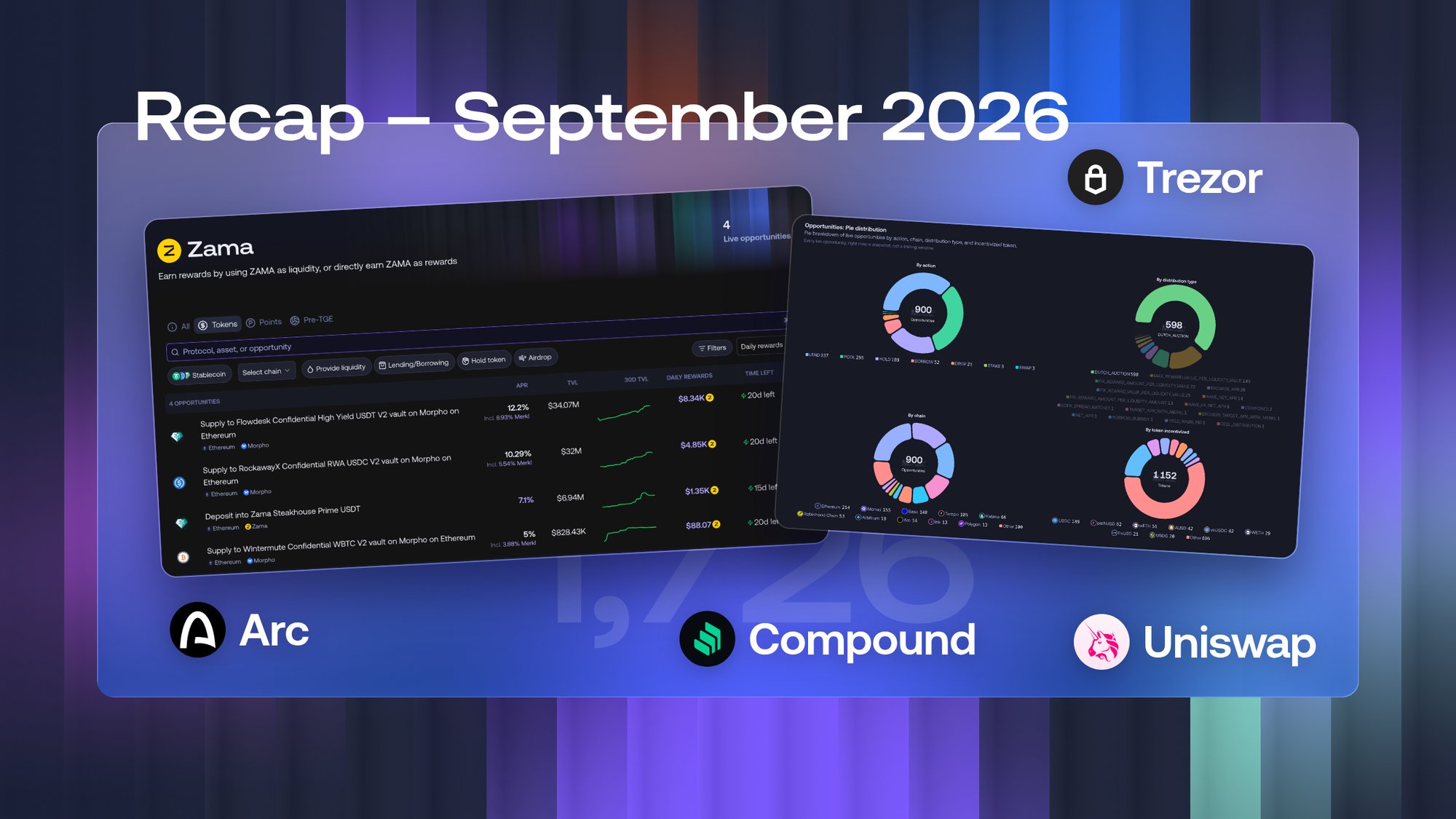
Monthly recap|Oct 19, 2026|5 min read
Monthly Recap: September 2026 – Confidential Incentives with Zama, Arc Mainnet, and More
Everything that shipped on Merkl in September 2026: confidential incentives with Zama, Arc mainnet, Compound COMP rewards, Concrete's CT airdrop, and more.
Read more →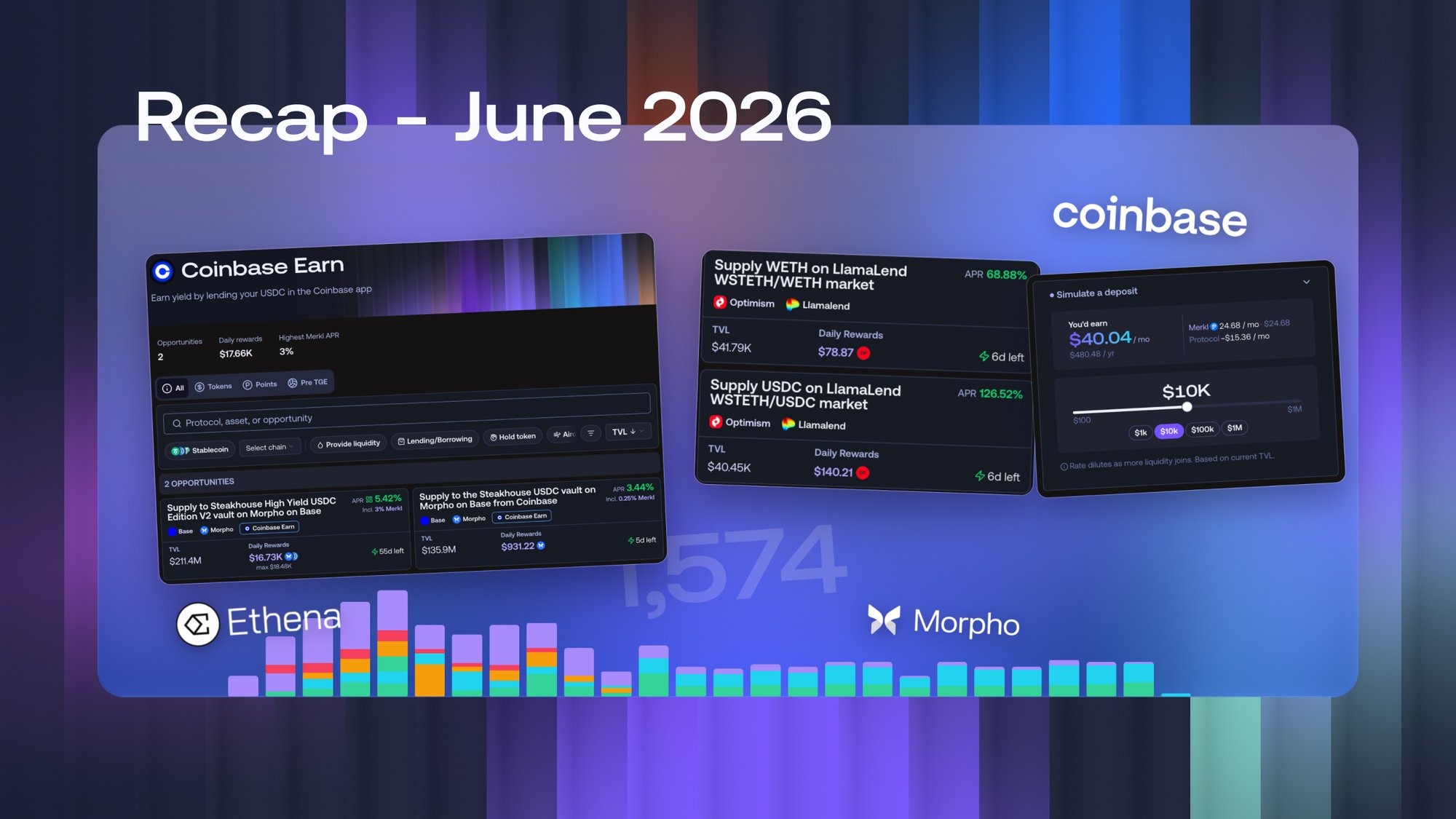
Monthly recap|Jul 21, 2026|3 min read
Monthly Recap: June 2026 – Coinbase USDC Lending, Deel Stablecoin Wallet, and More
Coinbase USDC lending, Deel stablecoin wallet, deposit simulator, and 1,574 new campaigns. Everything that shipped on Merkl in June 2026.
Read more →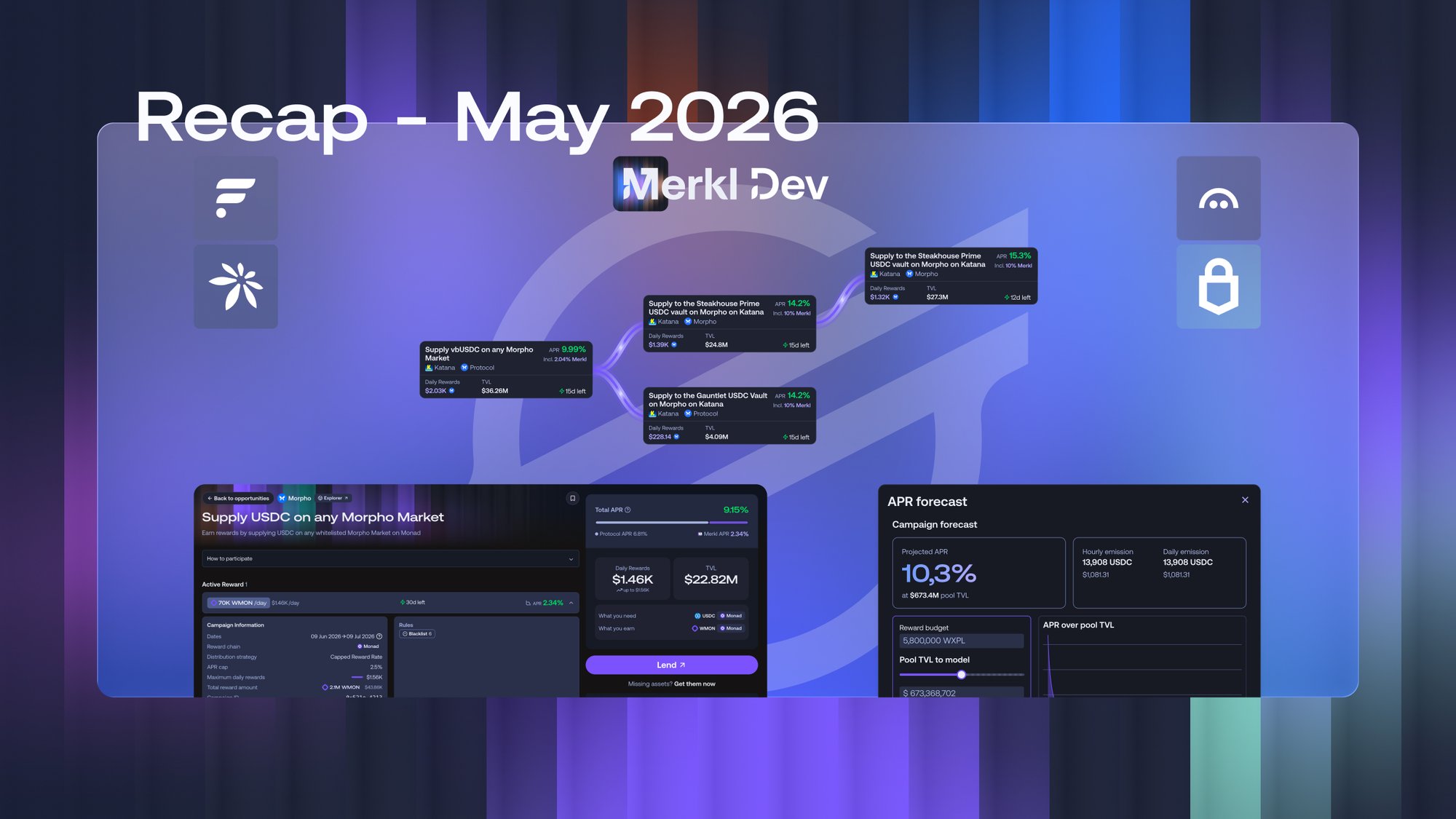
Monthly recap|Jun 10, 2026|4 min read
Monthly Recap: May 2026 – Non-EVM Chains, Trezor Vaults, and More
Merkl went live on non-EVM chains with Stellar, brought onchain yield to 2 million Trezor users, and launched a redesigned app and Developer Portal in May.
Read more →