The Merkl incentive platform is named that way for a reason. Can you guess why? It’s because its tech stack (the set of tools used to develop the Merkl engine) relies heavily on a data structure called "Merkle trees".
Let’s dive into what they are and how they work.

An efficient data structure
In computer science, a tree is a data structure where each node has children, just like in a family tree.
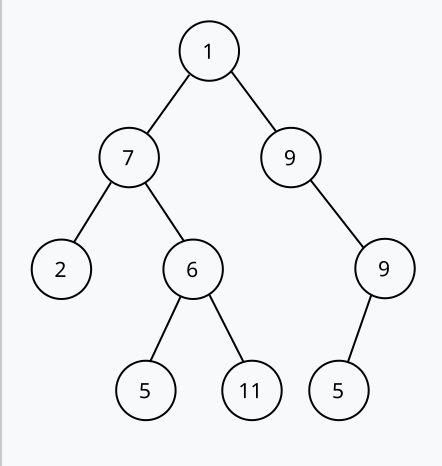
Consider the image above:
- The node 1 is called the root of the tree, and it has no parent
- All other nodes are connected to their parent
- The bottom nodes (2, 5, and 11) are called leaves because they have no children
Okay, but what kind of tree are we talking about?
A tree of hashes
A Merkle tree is a tree of hashes.
A data hash is like a unique fingerprint created by applying a special math formula (called a hash function) to a piece of data. No matter the size of the input (a word, a file, or a message), the hash always produces a fixed-length string of characters.
If even a tiny change is made to the original data, the hash changes completely. This makes it easy to check if data has been altered without re-reading everything.
For example:
- The hash of "cat" might be "a9f5b3..."
- But if you write "Cat" with a capital letter, the hash becomes "f72c1d...", totally different!
Hashes are widely used in cybersecurity, blockchain, and many other fields to secure and verify data integrity.
In a Merkle tree, each leaf node contains the hash of a data block, and each non-leaf node contains the hash of its child nodes.
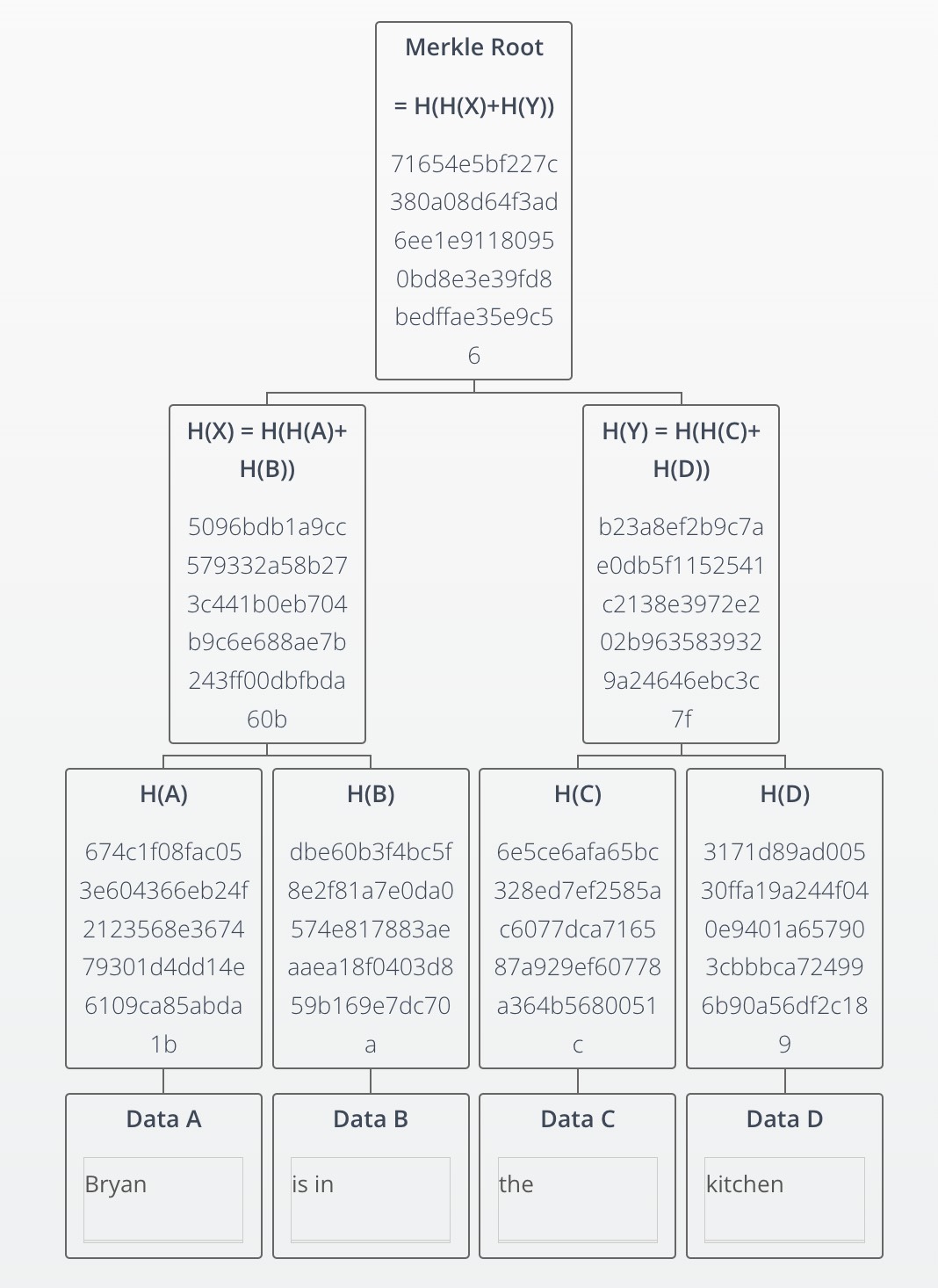
Consider the example above: the leaf 'Data A' contains the data 'Bryan.' Its parent contains the hash of this data H(A) . Its grandparent H(X) contains the hash of its two children H(A) and H(B), and so on.
Want to scale your business with Merkle trees?
How to create a Merkle tree
Creating a Merkle tree requires the following steps:
- Data hashing – Each piece of data (e.g., a blockchain transaction) is hashed.
- Leaf node creation – These hashes form the leaf nodes of the tree.
- Parent node creation – Pairs of leaf nodes are hashed together to create parent nodes.
- Root hash – This process continues up the tree until only one hash remains: the Merkle root.
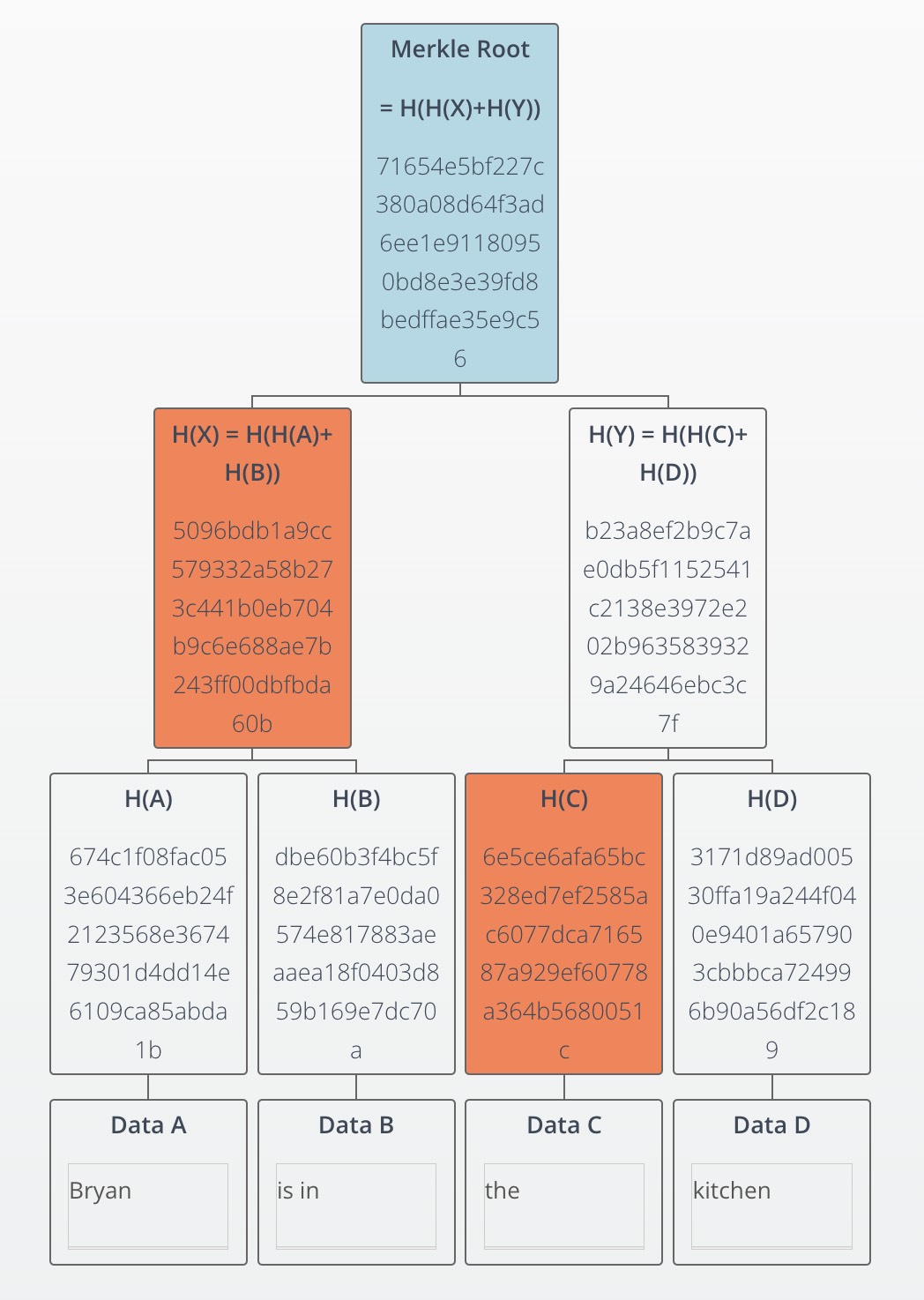
H(C) and H(X) are needed to complete the root and verify that the D leaf is part of the Merkle tree.
Now that you get how a Merkle tree works, you’re probably wondering: what’s it for?
The benefits of Merkle trees
Merkle trees offer several key benefits:
- Efficient verification – They enable quick validation of large datasets without processing all the data.
- Data integrity – Any modification to the data changes the Merkle root, making tampering easily detectable.
- Storage efficiency – Only the Merkle root needs to be stored, significantly reducing storage requirements.
- Fast data comparison – Comparing Merkle roots is much quicker than comparing entire datasets.
In our case, a Merkle tree is used to store all the rewards streamed through the Merkl incentive platform!
(And don’t mix them up. Merkl (the incentive platform) is spelled without an "e," while a Merkle tree includes one!)
Related articles

Tech|Feb 13, 2026|3 min read
How to Run Smarter Incentive Campaigns for Earn Products with Merkl
Learn how Merkl helps wallets and exchanges run smarter Earn product reward campaigns, boosting user rewards and maximizing budget efficiency.
Read more →
Tech|Nov 17, 2025|7 min read
What is Merkl? A Simple Guide for Everyone
Discover what Merkl is, whether you're new to DeFi or an advanced user, from finding yield opportunities to launching incentive campaigns.
Read more →
Tech|Jun 20, 2025|6 min read
How to Build a Point Program with Merkl
Learn about the different point programs — tokenized and non-tokenized — you can create with Merkl, and how to launch them.
Read more →