How Merkl Powered a $634M Refund While Keeping Funds Fully Secure

Solution
Merkl was selected to power the $634M USDC refund, thanks to its unique combination of scalability, reliability, and flexibility.
Handling an airdrop is one thing. Handling a $634M refund, where precision and security are critical, is another entirely.
To ensure absolute safety, Merkl designed an approach that allowed Hourglass to keep full control of the funds at all times, while still leveraging Merkl’s powerful distribution engine.
Instead of transferring funds to Merkl for distribution, which would have introduced unnecessary risk, Merkl engineered a secure solution.
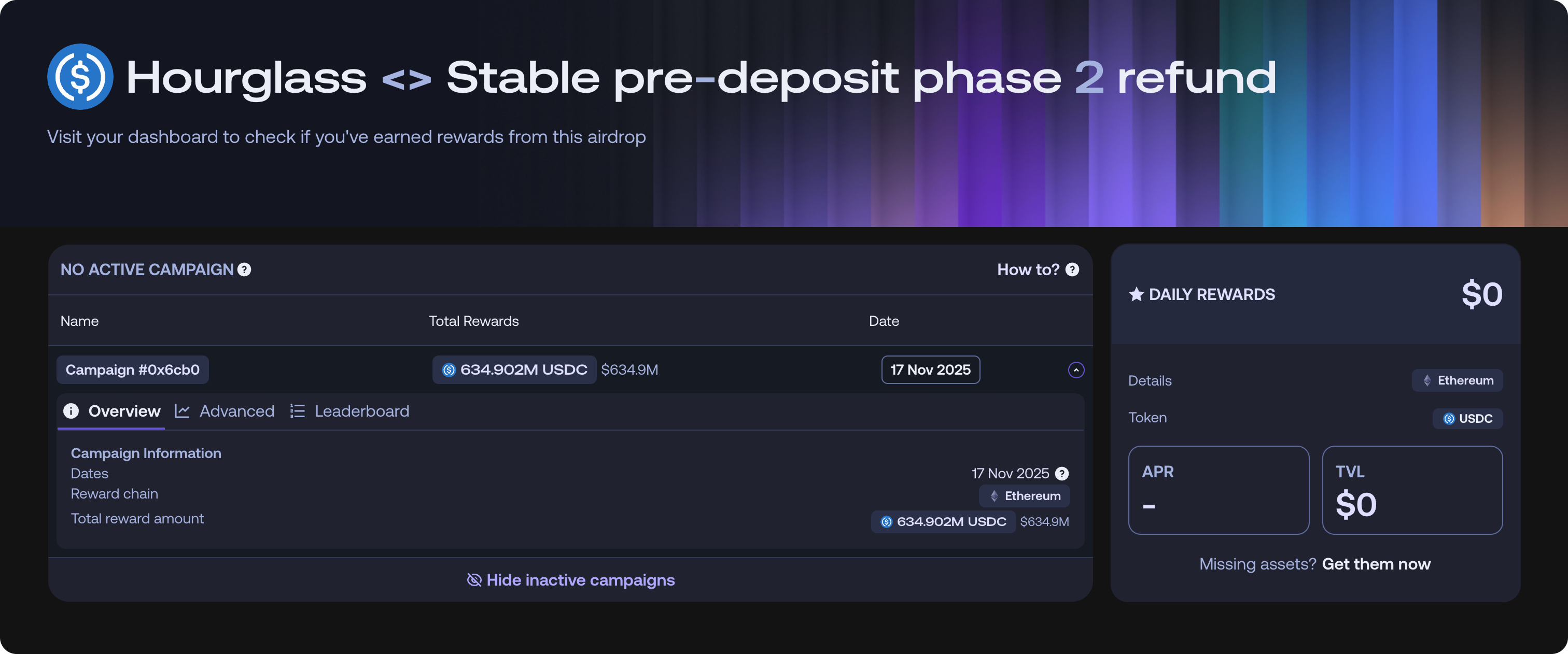
The Merkl team created a token wrapper contract that allowed users to claim their refunds through the familiar Merkl interface. To enable this, Merkl distributed placeholder tokens to eligible users.
When users came to claim their refunds, they interacted with these tokens as if they were receiving USDC directly. Behind the scenes, the wrapper contract triggered the actual transfer of funds, calling the Hourglass-controlled vault to send the correct amount of USDC to each user. Hourglass set initial USDC limits inside the vault that the Merkl wrapper contract was permitted to draw from. These limits were gradually increased over time as the refund progressed, allowing Hourglass to stay in full control of the funds while enabling Merkl to process claims efficiently.
For users, everything felt completely natural. The wrapper contract remained invisible in the interface, keeping the experience smooth and simple.
Only by inspecting the transaction on Etherscan could one see the more complex sequence:
- A claim transaction between the user and the Merkl wrapper contract
- Followed by an automated transfer from the vault holding the USDC to the user address
This architecture allowed Merkl to deliver a smooth user experience while guaranteeing maximum safety for large-scale fund handling.
What convinced us was Merkl’s ability to adapt their architecture to our security requirements. They delivered a custom wrapper flow that made the refund seamless for users while ensuring Hourglass retained strict control over the vault at all times.